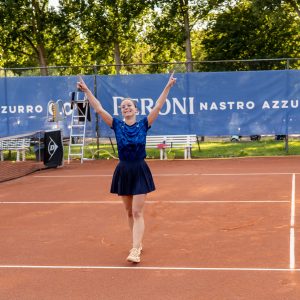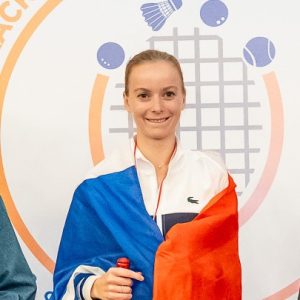
Finland surprised the racketlon world by winning the World Cup, claiming their first World Cup for 15 years.
At this, the elite level, team players are usually household names, and for sure Henrik Mustonen, Joel Pennanen, and Luka Penttinen are in the world of racketlon.
But the woman, Viivi Paksu and Toni Ruokanen, who played doubles on all matches with Joel, are not. Indeed Toni lost, albeit closely, in the first round of the B category here.
Toni has played just 32 international matches (exactly even on wins and losses) and Viivi just 15 (eight wins).
However, both were key to victory. In the three crunch games, GB and Germany in the group and France in the final, Toni and Joel were exactly even overall in their rubbers in the group and two up in the final.
Meanwhile Viiivi was 16 up against Matilda in the Great Britain match (Finland won by 20) and just six and nine behind Amke Fischer and world number one Pauline Cavé. It was a great performance against the Frenchwoman as their scores in the Teams was significantly tighter than the regular match they played in the elite singles, which Pauline won by 22, before tennis.
A fantastic squash player, Viivi maybe learnt some lessons from the first squash duel, as the scores on the squash court went from 21 18 to 11 3.
Team captain Joel Pennanen said: I am just so overwhelmed. We just had such a tough first day, competing against Germany and Great Britain and managed to come out on top on that.
And then just beating France in the final – it was a really tough final. I am happy about my team. They did such a great job.
I think squash [was key to victory]. We were down a lot before squash and we played really well. Viivi played phenomenal, and Luka as well and I managed to come back from 6 2 down to 11 8. So we did really well to come back from minus 30 or something. So that was really good squash from us.
It really was. It went from minus 34 before squash to minus 4 before tennis.
Elsewhere in the final, Henrik Mustonen was up against former long-time world number one Sylvain Ternon. The scores were 11 5, 11 2, 1 11, 14 16 – a vital win in the tie break in tennis for Henrik.
If it went the other way, and the next two sets stayed the same, the four-point swing would mean France’s Julien Castel would go into the final tennis set against Luka needing just six (five for the gummi), rather than ten and things could get nervy. (Not that elite players like these really show nerves like the rest of us…)
Luka’s performance overall against world number 10 Julien Castel was very impressive – 7-11 11-6 2-11 3-11.
Not that it strictly matters of course – you can only beat who you are up against – but Finland did have by far the harder route to it, having beaten Great Britain and Germany, as well as Switzerland, on the way to the final.
Great Britain had an only partly fit Leon Griffiths – he served underarm in tennis due to a shoulder issue. It was still, however, a strong team. +16 and +11 wins for Viivi and Luka helped them on their way to a 150-130 victory.
The Finns’ match against the Germans was an epic – 140-139. Henrik and Viivi were three and eight in the black respectively and the doubles was 35-35 so Luka Penttinen was the man of the hour, winning 12-14 2-11 7-11 11-8 (+12), including a clutch gummi-arm, finished with a smart volley, against Bastian Böhm, one of the best tennis players on the tour (it could also be his Germany teammate Joerg Kanonenberg).
Germany were extremely unlucky to lose in another gummi-arm to Great Britain in the final game of the group, to see who would get to play for (and very likely get) the bronze medal.
All rubbers were very tight. Indeed, the tie was the highest-scoring of all four team gummis over the weekend – 143-142 – and one of if not the highest scoring match of the weekend.
It was a heartbreaking end for the Germans and especially Bastian again on second singles. He need to win 11-0 or 11-1 for the victory – a near impossible task for anyone, even an outstanding tennis player like Bastian against a not-so-strong one. And yet even more improbable after Jonathan Ritter took the second point of the tennis set. Yet Bastian played flawlessly to win the next ten point and force the gummi.
Jonny served, a solid, deep serve, Bastian returned crosscourt, then Jonny hit a reasonable approach to Bastian’s backhand corner and came in – and Bastian struck it cleanly down the line…but, agonisingly for him and the Germans, into the tramlines. Racketlon can be a very cruel sport. (Especially as Bastian was four up in his individual rubber with Jonny.)
Meanwhile, in their group France enjoyed a +40 win against a Denmark side that, while still reasonably strong, was nowhere near as fearsome as Denmark teams racketlon fans have come to know, and a +73 victory over an injury-depleted Sweden team, which included Anna-Klara Ahlmer playing in the men’s rubbers (she did pretty well, claiming a 1-11 11-2 3-11 6-11 win against Rasmus Schønnemann of Denmark).
The gulf in the quality of the group was demonstrated by GB beating Denmark +24 for bronze and Germany beating Sweden +53 in the match for fifth.
Switzerland came in seventh as there was no eighth team.
Nations Cup
Elsewhere, the Teams categories were a veritable battle royale between France and Great Britain.
In the Nations Cup, their second teams met in final, after easing through the groups, GB with +62, +38, and +37 wins over Denmark 2, Germany 2 and Hong Kong 1, and France with +21, +48, and +28 wins over USA 1, Austria 1, and GB3.
Key for France two was having as their woman player Anaïs Ben Mansour, who had just won the singles World Championships title! Against USA 1, France 2 actually lost all the men’s rubber, but because she won her rubber +36 the overall difference was significant. She also bagged +28 and +26 scores against Austria’s Clarissa Steiner and GB3’s Ellie Thomas.
In the final, impressive table tennis and tennis helped Mollie Patterson keep the score to 36-23 (3-11, 11-1, 11-4, 11-7) to the Frenchwoman, while the boys did the business. Jamie Watkin-Rees and James Hempstead on singles and Henry Jones and Ross Wilson on doubles all beat their opponents (Jules Riss and Sandro Lena – and Stéphane Quiquempois and Jean Michot) with good margins.
Challenge Cup
It was a similar story in the Challenge Cup. France progressed to the final with +68, +43, and +30 wins over Germany 3, Hungary, and India.
Meanwhile, in their group, GB4 dispatched Netherlands and Switzerland with a minimum of fuss – scorelines of +50 and a huge +75. The only real test, in fact, came from France’s fourth team.
In this, France’s Théo Skibniewski edged his rubber against Kieran Shelley (FIR organiser and commentator) 38-37, Chloé Delpont ended three points up against Alexandra Ogram, and Antoine Durancer was one point in the black against Jack Taylor (they did not need to play the tennis).
However, GB4’s strength in depth showed as Matt Haynes and Johnny Bispham beat brothers Simon Bacha and Antoine Bacha +25. (A match-up of very close connections as Johnny was recently best man at Matt’s recent wedding and the French men are brothers.)
However, France 3 were, just, a bridge too far for the Brits. Matt and Johnny again won convincingly on doubles, +21 over Thomas Pauvert and Stéphane Chevallier, but in this case it was almost cancelled out by a very impressive win from Kilian Jouault-Couteau, 11-4, 11-5, 11-8, 11-8 over Kieran.
It went down to the wire – Jack Taylor needed nine against Victor Devinast, but the Frenchman, seemingly unaffected by nerves, took the win for France 11-3.
Hungary booked their place in the bronze medal match after a very dramatic match with India which went to a gummi-arm.
In the second men’s singles Balázs Francia, a very experienced racketlon player who only just lost in the Seniors +50 final, went up against 15-year-old Raghav Jatia, who made the semi-finals of the Juniors u16.
After Hungary won, they hugged Raghav, recognising what a tough moment it was and the fact Raghav had the courage to put himself up in the most pressured spot in the teams format, in an open age team! True racketlon spirit from him and both teams.
The match was also notable for the 33-0 score in the first three badminton sets to India.
Hungary brought in Peter Sákovics to bolster their team for the bronze medal match against France 4 and he helped them to a victory in the doubles, while Balázs Francia won by a commanding +18.
Satellite Cup
Great Britain took the inaugural edition of this cup, created due to the increasing popularity and quality of the World Championships Teams events – with 13 teams in the Satellite this year and eight in the Challenge Cup there would have been a record 21 teams in the Challenge Cup were it not divided (20 last year and 19 the year before). Those 13 battled it out in a monrad draw to be the first to etch their country’s name on the trophy.
Great Britain 5 enjoyed a bye as second seeds then cruised to victory in the quarter final over Germany 5, the only other team apart from the two seeds to get a bye, with the impressive record of not dropping a set across all 12 played.
There, they played Hong Kong 2, who dominated both France 6 then France 8. Hong Kong are traditionally very strong in the first half of racketlon matches so GB 5 did very well to only be four points down at halfway. There were a few big TT wins. An 11-5 score for Joel Durston and Cam Leighton in doubles against Ka Chun Lau and Anson Ng – a score that could have easily been the same the other way – and Ian Johnston, who has played the World Championships in ping pong (hardbat table tennis like on Marty Supreme), beat Sing Siu Lam 11-7.
A strong squash saw them five points up going tennis. Ishan Bairoliya played a solid set and won 11-5 and Kayleigh Chapman played a remarkably controlled tennis set to win 11-1, leaving Joel and Cam needing just two, which they got on the third point (they played on to win 11-5 and Ian win 11-9).
The France 5 led the charge of a whopping five French teams in this category – 5 to 9. But, such is the strength in depth of the game in France, the 7s, 8s, and 9s finished 5th, 6th, and 7th – credit to the selectors! (France 6 finished 13th.)
France 5 first beat USA 2 comfortably then their 7s by 12, although all of the men’s scores were basically exactly even – Magali Viaud proving the difference with a +15 win over Zoe Zanna. Then they faced Finland 2. Gaël Gautier and Antoine Taramasco on doubles were key, winning every set to win +17, in an overall +20 victory.
In the final, GB edged table tennis by two, some fine badminton by Antoine Taramasco (11-1) in men’s singles two against Ian gave France an eight-point advantage at half-time, which they extended into a plus 14 lead going into tennis. So advantage France. Great Britain has some strong tennis players but that is quite a lot of scoreboard pressure – realistically, wins needed from all four.
Ishan, Kayleigh, and Joel & Cam did that, with wins of 11-7, 11-7, and 11-8. This meant France’s Antoine Taramasco needed nine for the win and eight for the gummi. He was 8-7 up, with four matchpoints. Ian held his nerve through some tense, long rallies to bring up a gummi. Antoine won the toss and put Ian in to serve. Ian served, and Antoine hit it on the run and rushed the net…but put it a bit long, to the delight of the Brits (video).
Juniors
Starting at the youngest age, u12, it was a three-way shootout between the current powerhouses of racketlon in general – France, Great Britain, and Germany. All had points difference well in the positive in the group of four, with Germany edging the encounters against the other two (France u12 – 2 were the other team).
The same three nations had two teams each in the u14s and Austria and Czech Republic completed the eight draw. France were dominant here, claiming gold, while Great Britain showed great strength in depth, their 1s bagging silver and their 2s getting the bronze – and in fact the 2s got very slightly better results against the same opponents (France and Austria).
The u16 competition followed the Sam(e) familiar pattern. Robin and Romeo Sam – part of what, with older brother Leon included, could probably be deemed a racketlon ‘dynasty by now – helped Austria to this title again, like they did last year and like Robin did in 2024 (and Romeo was just seven points from doing in 2023 too).
They played all matches together here and dominated, winning 28 sets and losing seven. Lucas Augereau and Calixte Hoarau of France provided the stiffest competition, in the final, which ended 109-86.
France got even for that in the u18s, where they and Austria were the only entrants – and where Robin Sam also played. They won this 72-56.
Holly Ranson inspired GB to the u21 title. In the final they played Austria and the Austrian boys, Benjamin Radl and Markus Perschinka, were actually a smidge up in their matches when it ended but Holly’s 33-3 scoreline against Romy Northegger meant that the overall tie was a comfortable win for Great Britain. She also enjoyed a 44-6 score against Lia Paglia of Switzerland – only Germany’s Alina Reissenauer got close, with a margin of eight (11-5 11-2 6-11 9-11).
And to think, she is now off to university (Warwick) where she is on a scholarships to play probably even more sports…
Seniors